Thursday, July 27, 2006

Do it now or do it later?

One of the best articles Alan Caruba has written. This is from www.anxietycenter.com and the series of articles entitled: Warning Signs


July 26, 2006, Volume 8, No. 30


Do it now or Do it later?

We are beginning to see the national debate about what to do in the Middle East shape up into fairly specific sides. I call them the "Do it now" crowd and the "Do it later" crowd.

One can cite history to support either side. The "Do it now" crowd these days are called "neoconservatives" and they are led by people like Bill Kristol, editor of the Weekly Standard, a respected forum that makes ordinary Republicans look like wimps. Arguing for "Do it later" is George Wills, a respected conservative Washington Post columnist.

It should be noted that there is also a "Let’s not do anything" or a "Let’s run away" crowd who are called liberals and/or Democrats.

Maybe it’s just a trick of my imagination, but I seem to recall Americans of all descriptions just loving those images on television after 9-11 of the U.S. bombing the hell out of Afghanistan’s Tora Bora region where Osama bin Laden was said to be hiding or, better still, driving our tanks into downtown Baghdad. Later we found Saddam Hussein hiding in a hole in the ground.

Perhaps the most powerful argument for "Doing it now" is the fact that it’s been five years since 9/11 and the U.S. has not experienced another comparable attack. Keeping al Qaeda on the run, killing its leaders, and playing havoc with its funding was, in retrospect, probably a good idea.

Now the images on television are of war in Israel and Lebanon. Israel has been the subject of attacks since the day it declared its independence in 1948. It took awhile for the message to sink in, but its neighbors eventually figured out that massing armies on its borders was a very bad idea. They switched to a low-level war involving suicide bombers and rockets. Imagine how long we would patiently deal with Canada or Mexico if they were rocketing our cities and towns?

The "Do it now" crowd is now rooting for Israel to get rid of Hezbollah in Lebanon; mostly Palestinians who took up residence there after previously losing encounters with Israel and Jordan. First thing they did, of course, was to lay waste to Lebanon with a fifteen-year civil war pitting Muslims against Christians. Having no idea what peace is, other than the total destruction of Israel, Palestinians and other Arabs are once again learning what a bad idea it is to provoke yeshiva boys.

In Gaza, Hamas—another group of unhappy Palestinians—is also getting shot up by the Israelis. The Israeli’s "Do it now" crowd has concluded that waiting around for peace with Palestinians is a bad idea and a higher level of payback may prove palliative.

All of which brings us to our "Do it later" crowd who advise that waiting is just as good an idea, particularly as regards Iran who everyone knows is developing its own nuclear weapons capability. By way of a reminder, it was Iranians who in 1979 invaded the U.S. embassy in Tehran, seized our diplomats, and held them hostage for 444 days. It can be argued that most Iranians are being held hostage by the mullahs, but the funding and arming of Hezbollah comes from Iran.

The "Do it later" crowd always proudly points to how we patiently waited for the former Soviet Union to implode. The problem with that argument is that we also engaged in several proxy wars with them. Owing to Red China’s intervention, the best the U.S. could achieve was a stalemate in Korea and now we are stuck with a loony dictator in the north who has missiles and nukes.

Then there was that nastiness in Vietnam. Despite that loss the U.S. stayed busy sending troops to various places for the purpose of peacekeeping or swatting bad guys in Grenada, Panama, and Haiti. In 1983 Hezbollah blew up several hundred U.S. Marines who were in Beirut on a peacekeeping mission.

After the Soviet Union invaded Afghanistan, we funded and equipped Muslim holy warriors to drive out the Russians, thus helping to bring about the downfall of the Soviet Union. The Muslims, however, became al Qaeda and showed their gratitude by destroying the World Trade Center, flying a commercial jet into the Pentagon, and killing some 3,000 Americans.

The problem with waiting for Iran to become a nuclear power is that the leaders of Iran keep saying crazy things and promising to do crazy things. Even Arabs, no slouches when it comes to crazy, think the Persian, albeit Muslim, Iranians are really crazy.

So, while the warnings and recommendations of the "Do it later" crowd sound like a good idea, they rarely are. History is filled with examples of why "Do it now" is a better idea because failure to respond to Big Trouble almost always results in Even Bigger Trouble.

Every generation of Americans has had to learn this lesson. The nation has always been sharply divided over questions of war. This is what we pay Presidents to decide. After 9/11, we wanted the President to punish al Qaeda and, somewhat reluctantly, we agreed to his getting rid of a murderous despot in Iraq. Then we wanted that war to be over in two weeks.

History is rarely so accommodating. Wars tend to be very messy and this is especially true of the years after victory is declared. Militarily, we are still in Europe since the end of World War II in 1945. We are still in South Korea since 1953.

War is transformative and, even the most cursory look back at the past half-century or so reveals that the U.S. has benefited itself and much of the world by opposing evil. Wherever the forces of evil may be and whomever they might call themselves, we still need to be able to "Do it now" because power-crazed lunatics will always find an excuse to make trouble.

As we debate whether to "Do it now" or "Do it later" regarding the Iranian mullahs, perhaps we should recall British Prime Minister Neville Chamberlain who, after negotiating with Adolph Hitler, returned home to proclaim "peace in our time."

There is no substitute for victory

As this is written, George W. Bush is the subject of mockery and disdain, but sixmonths after the liberation of Baghdad by American and British forces, on November 6, 2003, he reminded the nation that "Sixty years of Western nations excusing and accommodating the lack of freedom in the Middle East did nothing to make us safe—because in the long run, stability cannot be purchased at the expense of liberty."

On May 12, 1962, one of the greatest generals of World War II returned to West Point to deliver a farewell speech. Douglas MacArthur spoke as a soldier of one era to the young soldiers who would take up the duty of defending the nation. He told them, "Yours is the profession of arms, the will to win, the sure knowledge that in war there is no substitute for victory; that if you lose, the nation will be destroyed, that the very obsession of your public service must be duty, honor, country."

"Others," MacArthur said, "will debate the controversial issues, national and international, which divide men’s minds. But serene, calm, aloof, you stand as the nation’s war guardians, as its lifeguards from the raging tides of international conflict, as its gladiators in the arena of battle."

Today, there is no lack of controversial issues and no lack of enemies who challenge our nation and the values of Western civilization on which it is based. Those values began 2,500 years ago with a tribe of people, the Hebrews who entered into a covenant with a God they deemed to be the creator and lord of all mankind.

Take away the Jews and there is no Judaism. Take away Judaism and there is no Jesus and no Christianity. There would have been no Diaspora and no Renaissance, no Reformation and no Enlightenment. The only constant to which one can point is the Jews. Empires and Nations rose and fell, but always, always there were the Jews, keeping the covenant, observing the laws, lighting the Sabbath candles, reading from the Torah, and yearning to return to Jerusalem and their promised land.

Perhaps the most astonishing thing that occurred in the twentieth century was that return, that resurrection, of Israel.

On May 14, 1948 Israel’s independence was declared. The Arab response was war. Israel fought again for its survival in 1967 when adjacent Arab nations attacked. Again in 1973, on the eve of Yom Kippur, one of the holiest days of Judaism, Israel was attacked. Each time it successfully fought off the Arabs. In 1977, Menachem Begin became Prime Minister of Israel and in 1978 he would share the Nobel Peace Prize with President Anwar el-Sadat of Egypt as the result of their peace accords. Sadat’s efforts for peace were rewarded with assassination.

Begin was well known to those early, first Israelis. He had served in the Irgun Zvai Leumi, an organization that forced the British to relinquish control of what was then called Palestine, a name first given it by the Roman Emperor Hadrian who thought it would erase all memory of Israel.

It remained the given name of the area when, after World War I, the British and French drew lines on the map of the Middle East to create Lebanon as a French Protectorate and Palestine as Britain’s. Other nations created were Iraq and what was then called Trans-Jordan.

Following the day in 1948 when a provisional Hebrew government was announced, Iraq, Jordan, and Egypt prepared to attack the re-born Israel. Menachem Begun went to a secret radio station in Tel Aviv. Virtually every home in the land was tuned to listen.

"One phase of the battle for freedom, for the return of the whole people of Israel to its homeland, for the restoration of the whole land of Israel to its God-covenanted owners, has ended," he said. "The state of Israel has risen…through blood, through fire…it could not have been otherwise…and it is compelled to fight—or to continue to fight satanic enemies and blood-thirsty mercenaries, on land, in the air, and on the sea."

"The first pillar of our state must therefore be victory, total victory, in the war which is raging all over the country, said Menachem Begin, eerily echoing the words of General MacArthur at West Point. "Whoever does not recognize our natural right to our entire homeland, does not recognize our right to any part of it."

And he reminded the new citizens of Israel; "We cannot buy peace from our enemies with appeasement." Facing the first war of national survival, he told them that, "in this battle we shall break the enemy and bring salvation to our people, tried in the furnace of persecution, thirsting only for freedom, for righteousness, and for justice."

Nearly sixty years after Begin addressed his people, Israel is still the only truly free nation in the whole of the Middle East. It constitutes barely one percent of the total area occupied by its Muslim enemies. Israel’s population of 6.4 million people is equal to two percent of the combined 315 million Muslims of the nations surrounding and threatening them.

A friend of mine asked, "Why does 98% of the Middle East’s population with 99% of the land hate Israel so much? It is a mystery that defies explanation." It is no mystery. The reason is Islam, a religion that holds all other religions in utter contempt, but especially the Jews whose ancestors had refused to recognize Mohammed as a prophet.

Finally, in this hour of blood and fire for both America and Israel, the words of another U.S. General, George S. Patton, Jr. are worth recalling when, on the eve of the invasion of Europe, he told his troops, "Americans love to fight, traditionally. Americans love the sting and clash of battle. Americans love a winner. Americans will not tolerate a loser. Americans despise cowards. Americans play to win."

The wavering, the calls for cease-fire, the urgings for appeasement and withdrawal are not the foundation upon which great nations are born and based.

In Iraq, Americans must play to win and so must Israel in yet another hour of another war it must not lose. Our fates are intertwined; our destinies are the same. The issue is freedom and the battle must be joined. There is no substitute for victory.

"Warning Signs" is the Center’s way of helping Americans and others gain an insight to both national and international events, issues, and trends that will protect our interests and those of others striving toward freedom everywhere. The Center needs your donation to maintain this effort. If you prefer to send a check, please make it payable to The Caruba Organization, 28 West Third Street, Suite 1321, South Orange, NJ 07079.

Coming in September, Alan Caruba’s new collection of his commentaries written between 2003 and 2005. To learn more about "Right Answers: Short Takes on Big Issues", click here.


© 2006 Alan Caruba.
All Rights Reserved

Monday, July 24, 2006

Another Birthday

Apart from sharing my Birthday, July 25th, with Iman ( David Bowie's wife) amd Matt LeBlanc, the famous spy Mata Hari was shot on this day in 1917. There's more


1978
The world's first test tube baby, Louise Joy Brown, is born at Oldham General Hospital in the north of England.
1962
In London, the Buckingham Palace Art Gallery officially opens to the public.
1959
A Hovercraft - the SRN 1 - makes its first English Channel crossing from Dover to Calais in a little over two hours.
1946
The United States detonates an atomic bomb at Bikini Atoll in the Pacific Ocean.
1944
World War II: The Germans first use a jet fighter - the Messerschmitt 262 - in aerial combat.
1943
World War II: Italian dictator Benito Mussolini is forced to resign.
1917
World War I: Dutch spy Margarethe Zelle - known as exotic dancer Mata Hari - is sentenced to death.
1909
French aviator Louis Bleriot becomes first man to fly across Channel from a field near Calais to Northfall Meadow near Dover Castle, England.
1907
In England, Sir Robert Baden-Powell begins an experimental camp on Brownsea Island near Poole to test the feasibility of Scouting. Four days later he forms then Boy Scout organisation.
1814
English inventor George Stephenson demonstrates the first steam engine.
1603
James VI of Scotland is crowned James I of England.

Are we being short-sighted?

From the UKIP's website - comments by Nigel Farage on the possible future problems caused by the addition of Bulgaria and Romania to the EU. My take on immigration, illegal or otherwise, isn't always in line with my colleagues in UKIP. I'm more of a pragmatist. If we genuinely need workers from these countries, then allow them in - but on a restrictive visa arrangement.................................


Immigration: All spin and no action

24-07-2006


The Home Secretary's plans for stricter border controls were today (24.7.06) condemned as "a farce".

The apparent promise by John Reid for a single border control agency, which would control British airports and ports, is nothing more than a window-dressing exercise, the UK Independence Party said today.

"Putting passport officers in uniforms will do nothing to reverse the rocketing immigration into this country" said UKIP MEP Nigel Farage. "Even the announcement of more staff is nothing more than spin, since they will simply be making up the deficit of immigration officers which this Government has allowed."

Mr Farage continued: "This is the same Home Office who predicted immigration from Eastern Europe of only 13,000 a year, when in fact the figure is 600,000 and rising."

Of more concern to the Home Office should be the influx of immigrants from Bulgaria and Romania, who are due to join the EU in January 2007. A leaked memo showed that around 45,000 heading for the UK are criminals.

Mr Farage added: "This Government is still perpetrating the myth that they can do something about who enters our country. In fact, the only way John Reid can halt these criminals entering the UK is by halting the automatic right of residence and employment which EU nationals currently have.

"Once these people are in the UK, it will be illegal for the Home Office to deport them under EU rules. Mr Blair must take a firm stand and veto the accession of Bulgaria and Romania when the topic is debated in October."

Germany and France are among two EU countries who did not grant these rights to the enlargement nationals, and they have seen their immigration decline.

Notes:

Bulgaria and Romania are due to join the European Union in January 2007. Under EU rules, the UK is forbidden from discriminating on grounds of nationality even if a person is convicted of a criminal offence.

Friday, July 14, 2006

Sam Sodje to Reading FC


So Sam finally did it! He'll be the first Margate player to play in the top flight of English football since Tommy Jenkins went to Southampton after a spell at Reading 35 years ago.

The photo shows me interviewing Sam at Brentford FC for BBC Kent just a few months ago.

And where has Sam been transferred to..............Reading FC

Lord Levy & The "Honours" System

So our Prime Minister maybe interviewed by the Met. over the "cash for gongs" affair. Personally, I think all three main parties are as bad as each other. My take on our so-called honours system is very much in line with these comments taken from an anti-EU campaigner...............................


I've had time to go through the full list of Honours given out earlier this month:


This year’s Queen’s Birthday Honours list (drawn up by the pro-EU establishment, politicians and civil servants and not by the Monarch) includes awards for cheesemakers, the ape alliance, beekeepers, a fish and chip shop owner, bowling, brass bands, fencing and carrot growers. There are Honours for people working with the EU and for organisations that are part of the EU ‘regionalisation’ policy to break up the UK (of which the Welsh Assembly and the Scottish Parliament are a part). And there are lots of awards for ethnic minority organisations – many of them funded by British taxpayers’ and council taxpayers’ money.

But, as usual, the pro-EU establishment has made sure that its list of Honours is typically politically correct and includes no awards at all for any groups or organisations promoting Englishness – and there can’t be any awards for anyone working for an English Parliament because there isn’t one (and the anti-English Labour Party intends to keep it that way).

Quite disgracefully, the anti-EU Democratic Unionist Party (DUP) of Dr. Paisley was, for thirty years, snubbed by the europhile establishment – denied even a single place in the House of Lords (and no Honours). Only after the DUP won half the parliamentary seats in Northern Ireland to become the fourth biggest party in the Commons (in May 2005) did the establishment relent and make Eileen Paisley (wife of the DUP leader) a Peer. For the anti-EU UK Independence Party – and any other anti-EU campaigners – there are no places in the Lords (unlike all the other political parties that won seats in the EU Election of 2004) and no Honours. Carrot growers, the owner of a fish and chip shop, beekeepers, brass bands and the ape alliance take preference over the millions of anti-EU people in the UK as far as the pro-EU establishment who dish out these Honours are concerned.

The following is a selection from the long list of Queen’s Birthday Honours published on 17.6.2006:

Honours for people working for regional/devolved organisations/bodies or those promoting and/or supporting the EU-backed ‘regional’ and/or devolved organisations:

Order of the Bath KCB: John Elvidge, Permanent Secretary, Scottish Executive

Order of the British Empire, CBE: Dr. Hamish Robert McHattie Wilson, formerly Head, Primary Care Division, Scottish Executive

Order of the Bath CB: Alan Pritchard, formerly head, Economic Development and Transport Department, National Assembly for Wales

Order of the British Empire, OBE: Julian Burrell, ‘Chair’ Wales Tourism

Order of the British Empire, OBE: Barry John Dodd, ‘Chair’ and Chief Executive GMS Group and Board member Yorkshire Forward, for services to Business in the Humber Region and Yorkshire (Yorkshire Forward backs the unwanted Yorkshire ‘regional’ assembly)

Order of the British Empire, MBE: Mrs. Ann Elizabeth Lewis, Audio Typist and Clerk, Ashford Employment Tribunal Office, Department for Constitutional Affairs

Order of the British Empire, MBE: Philip Rolf Harding, Head, Sustainable Business Government Office for the south-west, Department for communities and local government

Order of the British Empire, MBE: Miss Hannah Rita Jones, Head, Farm Liaison Team, National Assembly for Wales

Order of the British Empire, OBE: John Angus Mackay, Chief Executive, Gaelic Media Service, for services to broadcasting in Scotland

Order of the British Empire, MBE: Herschel Post, ‘Chair’, Earthwatch, Europe, for services to the Environment


Honours for people working with or for the EU/or people promoting EU policy:

Order of St. Michael and St. George CMG: Miss Gillian Mary Anne Lambert, Deputy UK Permanent Representative to the EU in Brussels

Order or St. Michael and St. George, CMG: Julian Beresford King, Political and Secretary Council Representative, Office of the UK permanent Representative to the European Union

Order of the British Empire, OBE: David John Capel, Team Leader, EU Student Finance Team, Higher Education Directorate, DFE skills

Order of the British Empire, MBE: Michael Randall, Director of Recycling, for services to Waste Management in Northern Ireland (Recycling promoted due to EU Directive banning landfill waste sites)

Yet again, not one single Honour/award for any organisation promoting Englishness or with the words ‘English’ or ‘England’ in its name – but plenty of Honours for people involved in ethnic minority organisations/matters:

Order of the British Empire, CBE: Miss Sarah Veale, Head of Equality and Employment Rights, Trades Union Congress for services to Diversity

Order of the British Empire, OBE: Shun Ying Au, ‘Chair’ and founder, Chinese Mental Health Foundation for services to the Chinese community

Order of the British Empire, OBE: Jeremy Ian Crook, Director, Black Training and Enterprise Group for services to community relations and to Diversity

Order of the British Empire, MBE: Rashid Ahmed Awan, President, Pakistan Society of West Yorkshire for services to community relations

Order of the British Empire, MBE: Fitzroy John Batchelor, for services to Black and Ethnic minority people in the NHS

Order of the British Empire, MBE: Mrs. Sudarshan Bhuhi, for services to the Asian community in East London

Order of the British Empire, MBE: Ninian Vernon Le Blanc, Director, Diversity and Inclusion, Royal Mail for charitable services

Order of the British Empire, MBE: Delisle Cumberbatch, for services to African Caribbean people with Mental Health Problems in Tower Hamlets, London

Order of the British Empire, MBE: Mohindra Dhall, Founder, Scottish Indian Arts Forum, for services to the arts in Scotland

Order of the British Empire, MBE: Babulal Sudra, for services to the Gujarati community in Redbridge, London

Order of the British Empire, MBE: Mrs. Geslyn Agatha Malcolm, Treasurer, Pineapple Luncheon Club for services to Black and Minority Ethnic People in Ethnic people in south-east London


Honours – controversial:

Order of the British Empire, OBE: Professor Michael Anthony Lennon, ‘Chair’, British Fluoridation Society (BFS) for services to Dental Health (BFS promotes the enforced mass medication of the British people through fluoridation of water supply)

Order of the British Empire, MBE: Arthur Thomas Barrett, Food Secretary and Livelihooods Adviser, Zimbabwe Department for International Delivery (Zimbabwe’s government has been criticised around the world for its human rights abuses)

Order of the British Empire, MBE: Dr. Sultana Feroze Al Qu’aiti, for services to disadvantaged communities in Yemen and to British relations with Yemen and Saudi Arabia (Saudia Arabia executives people in public at lunchtime and chops off the arms of those breaking certain laws)


Honour – inexplicable

Order of the British Empire, MBE: ‘Ms’ Yvonne Williams, Sustainable Development Officer, Lichfield District Council, Lichfield District Council, Staffordshire, for services to local government (Sustainable development?)

Honour to Labour Party member:

Knights Bachelor: Charles Cleese CBE, Leader Manchester City Council for services to local government

The pro-EU establishment regards the following people/organisations as more important than Honours for anyone from UKIP or any other pro-sovereignty organisations: Honours to obscure and ‘low profile’ organisations/not very well known people:

Order of the British Empire, OBE: Dr. Nigel Hewett, ‘Chair’, Leicester Rough Sleepers multi-disciplinary team for services to homeless people

Order of the British Empire, OBE: Randolph Hodgson, ‘Chair’, Specialist Cheesemakers’ Association, for services to the Dairy Industry

Order of the British Empire, OBE: Ian Michael Redmond, ‘Chair’, Ape Alliance and Co-founder, Elefriends and the UK Rhino Group, for services to conservation

Order of the British Empire, MBE: Mohammed Ali JP, for services to the community in Derby (no Honours for any doctors of any other religion)

Order of the British Empire, MBE: Constance Ann Brown, Fish and Chip shop Proprietor, for services to business and to the community in Pembrokeshire

Order of the British Empire, MBE: Mrs. Jill Edwards, for services to golf in Wales.

Order of the British Empire, MBE: Robert Jack, for services to bowls

Order of the British Empire, MBE: Alan Lawton, for services to Brass Band Music

Order of the British Empire, MBE: Gerald Hornby Moxon, Council member, Yorkshire Beekeepers’ Association, for services to the Beekeeping Industry

Order of the British Empire, MBE: Mrs. Eileen Dorothy Pitman, Coach and Founder, Portslade Fencing Club, for services to sport in Sussex

Order of the British Empire, MBE: Clements Harry Tompsett, ‘Chair’, British Carrot Growers’ Association, for services to Agriculture and to the community in Cambridgeshire

Order or St. Michael and St. George, CMG: General Ralph Zacklin, formerly Assistant Secretary, United Nations Secretariat (the United Nations in an internationalist organisation which is backed by europhiles in the UK)


Is it time to get rid of the Honours System?

A fresh perspective on Israel from Alan Caruba

Alan Caruba sent me this from his base in the US.

It's Always Israel's Fault
by Alan Caruba

We live in a world where hijackers, primarily from Saudi Arabia, can commandeer two airline jets to destroy the World Trade Center and, within hours, the word is spread that this heinous act was really the work of the Israeli Mossad and Jewish terrorists.

We live in a world where, despite ceding Gaza to the Palestinians, a tunnel is built by Hamas to facilitate the killing of two Israeli soldiers and the kidnapping of a third, while rockets rain down daily, and yet Israel is ultimately blamed because it is the “occupier” and holds Palestinian terrorists in its jails.

We live in a world where Hezbollah can take two Israeli soldiers hostage a few days later and flee back across the border into Lebanon. Apparently, Israel’s military withdrawal from Lebanon in 2000 was insufficient reason to cease such outrages.

This brings us to the UN’s Division for Palestinian Rights, a branch of its Department of Political Affairs. Every year since 1977, it has organized a meeting in New York on November 29 to deplore the General Assembly’s 1947 Partition Plan that was accepted by the Israelis and unanimously rejected by Arab states. The meeting is a platform for speeches denouncing the existence of Israel, all paid for by the UN.

When the body of the former UN Human Rights Commission stank so rankly of its own putrescence, it was rhetorically replaced with a Human Rights Council and on July 6, 2006 the Council ended its first-ever “special session” with a resolution condemning Israel for the latest problems in Gaza.

Briefly, Gaza is a sliver of land adjacent to the Egyptian border from which Israel withdrew, forcing its own citizens who lived there to abandon their homes and communities. The hope was that by ceding Gaza to the Palestinians, it would lead to peace. It led to the election of Hamas, a terrorist organization solely dedicated to the destruction of Israel.

When Israel retaliated against the latest provocation, demanding the return of the young soldier, it was the considered opinion of the UN Human Rights Council that Israel was guilty of causing a humanitarian problem. The vote was 29-11 with five abstentions.

The Council’s resolution included a call “to dispatch an urgent fact-finding mission headed by the Special Rapporteur” et cetera, et cetera. The man selected for this mission is John Dugard and, as UN Watch, an independent non-governmental organization noted, he has held this position since 2001 and has the dubious record of never finding a single Palestinian guilty of anything. After a pro forma expression of sympathy for Corporal Gilad Shalit, the Hamas hostage, he added that he felt the same “for all Israel’s young soldiers compelled to serve in the army of an occupying power.”

According to UN Watch, this same “occupying power” has, over the past four years, been subject to more than 140 separate suicide attacks and 13,730 shooting attacks. Dugard failed to mention them.

The United States has been oddly quiet of late regarding events in Gaza, noting only that the kidnapping was a terrorist act. Perhaps the State Department has concluded there is nothing that can be done to persuade the Palestinians to act in a sane fashion.

The Israelis have tried every thing they could to mollify the Palestinians and the neighboring Arab states. They have done this despite having fought several wars that gained it the territories the Arabs want returned, along with all of the rest of Israel.

There is a lesson here somewhere for the Israelis and for the rest of the world. It has something to do with punishing one’s enemies until they give up. It has something to do with the lesson the Holocaust should have taught them. You cannot negotiate with people who want to kill you.

-----------
Read more articles like this at HUMAN EVENTS ONLINE!
http://www.humaneventsonline.com/

Saturday, July 01, 2006

The Battle of the Somme - July 1st, 1916

I've been very impressed by the media coverage of the above event which started 90 years ago today. It's right and proper that we don't allow the football mania, currently gripping the country, to shroud important historical events.

It's difficult to imagine the carnage that took place on that first day. Tens of thousands were slaughtered or injured in the first few hours. In total there were over 120000 casualties.

Apparently, the opening salvos could be heard across the channel at Hastings.

Sunday, June 25, 2006

Beckham Vomits, England Win

OK, my earlier cynicism has changed to hopeful expectation. A hard-fought 1-0 win over the guinea-pig eaters has secured a quarter-final tussle against either Portugal or the orange inferno, Holland.

I can hardly wait!

(Following the battle of Nuremberg this evening, a depleted Portugal will take on Sven's boys)

Thursday, June 22, 2006

The England forward line

It really does beggar belief doesn't it. The crocked Michael Owen has now returned home and we are left with the dubious aerial power of Peter Crouch, Wayne Rooney and an untried kid called Walcott. At home there's Andy Johnston, Jermaine Defoe and one or two others who are tried and tested goalscorers. And yet somehow we are expected to believe that we can power past Ecuador then either Portugal or Holland in the quarter-finals with the abovementioned trio.

Lady luck - are you there?

Wednesday, June 21, 2006

Pesce Controladar Sensi Morte

Not what you're thinking...........right!!

A sign alongside various mountain streams in the Pyrenees does not say "Controllled fishing, do it and we'll kill you!"

Rather, it actually says in Catalan, well loosely translated anyway............."Fish here, but please throw them back"

More on my break in France and the Spanish Pyrenees later...........

Sunday, June 11, 2006

PARAGUAY


Ok, so we beat Paraguay 1-0. All very well but the second-half performance was, to say the least, a bit quiet. Heat, that terrible natural phenomenon, was responsible for the slovenely manner in which certain players went about their business. Play it in November I say.

OK, 29 degrees of heat in the cauldron of the Waldstadion in Frankfurt may not have been the best playing conditions but really...............Trinidad & Tobago next, a mouthwatering prospect that is. I shall be watching it from the luxury of my Pyrennean hotel room.

Come on England

Friday, June 09, 2006

June 14th, 1970

England 2 West Germany 3 - an awful result. Too much for a young Jeremy to cope with!! Since then, every World Cup campaign has been littered with disappointment. Thank heavens I was alive in 1966, and saw, albeit in black & white, Geoff Hurst thunder home that left foot shot in extra time at Wembley.

Having suffered that 1970 humiliation (all Peter Bonetti's fault) we then had the Polish "clown" Jan Tomaszewski. He stopped everything that the England forward line could throw at him - including the kitchen sink! Our exit from the 1974 finals at the qualifying stage meant further depression for a young Jeremy and for the country at large. Mind you Margate did lift the Kent Senior Cup for the first time since the 30's a few months later. Hardly consolation.

So Scotland carried the hopes of the British Isles in Germany in 1974. They managed a 0-0 draw aginst Brazil but failed to score an adequate number of goals against Zaire and were eliminated. Scotland eliminated. That sounds so good!

The pundits tell us that the assembled English squad for Germany 2006 has a great chance of lifting the World Cup. I don't think so for a variety of reasons. I'll highlight them upon our certain demise at the quarter-final stage.

Pessimistic, moi. Never.

Monday, May 29, 2006

What's in a name or brand?

A few days ago, I was working with a colleague of mine J J Gabay. We were in discussion with an organisation who were looking at different ways to create better brand names for their clients. The following 9 tips may be of assistance. They were written by, Laura Ries from US based, Ries & Ries, a marketing strategy company.

Info on brand naming:

Selecting an appropriate name for your business is without doubt one of the most difficult tasks. Making that final decision is a lofty goal, as it is the chosen name that takes you out to your clients and consumers. However, to successfully select the most promising name, research is extremely important.

What is it that needs to be looked at when researching? There are certain questions that must be placed when selecting a name for your business. It is vital to find out whether the name has the potential of attracting expansion and growth prospects, as well as clients and customers; all depending on the nature of business. Also important is whether the name communicates the appropriate message or otherwise.

The primary stage of research includes brainstorming, whereby you make a list of probable names. Once you have an exhaustive list, discard all the unattractive ones. Gradually, bring the list to the top 3-5 names. This is where actual ‘Brand Naming Research’ comes in. In order to determine the viability of each name it is essential to look into certain important questions such – your target audience; what is it you want to sell to them; what would appeal to them most with regards to your product or service; the names used by your competitors.

While researching it is essential to keep in mind your prospective market in terms of clients and customers or consumers. If your business is top cater to Industrial Clientele then the names has to be descriptive, i.e., stating the service or product provided. For instance, Steels India Limited. On the other hand, if you business is Consumer-based- Clientele, then the name has to be creative, innovative and attractive. For instance, Glucose Biscuits or Surf Washing Powder.

As it is said anything researched carries more weight of success than anything that is brought out of the ordinary, just like that.


The 9 keys to naming success.


The single most important marketing decision a company can make it what to name a brand. A brand’s power lies in its ability to grab a position in the mind of the consumer. With a poor brand name you make the job of getting into the mind that much harder. With a great brand name you can help your brand down the road to success.

It’s not that a brand with a poor name won’t ever succeed. Many do. If you price something cheap enough, it will move in spite of a dreadful name. Hyundai, for example, sold 400,221 vehicles in the U.S. last year. But did you ever hear someone say, “Eat your heart out, I just got myself a 2004 Hyundai?” Is Hyundai a powerful brand? I think not.

Some powerful brand names include: Lexus, Red Bull, Google and Starbucks. The 9 keys that follow will help you pick the best name possible for your brand. Don’t expect a name to meet all the nine requirements but if it covers more than a few you’ll know you have a winner.

Key #1: Short.

In general, the shorter the better. The longer and more complicated a name the more difficult it is to remember. The Internet has made this an even more important issue, since a website is the first place many people go to find out more about a brand. With a website address the less typing the less likely there is for error.

Some examples of short names: Tide, Apple, Crest, Nike, Gap, TiVo, Rolex.

Some examples of names that are too long: Morgan Stanley Dean Witter, Deloitte & Touche, Bausch & Lomb, TIAA-CREF.

Key #2: Simple.

Simple is not the same as short. Simplicity has to do with the alphabetical construction of a brand name. A simple word uses only a few letter of the alphabet and arranges them in a combination that repeat itself.

Schwab is a short name (six letters), but it is not a simple name because it uses six letters of the alphabet. This is one of the reasons it is not particularity easy to spell. Mississippi is a long name (11 letters), but it is also a simple name because it only uses four letters of the alphabet. Which is why most people can spell Mississippi.
Some simple brand names: Coca-Cola, Nissan, Google, Hennessy.

Key #3: Suggestive of the category.

A generic name is not as powerful as a proper name. But a name that is suggestive of the category can help consumers identity what your brand stand for. One way to achieve this is by shortening the generic for the category. You create a proper name that is short and easy to remember. Soy milk became the brand name Silk. Vanilla cookies became the brand name Nilla.

Another way is by using a word out of context that suggests the category.

Some suggestive names: Blockbuster Video, Curves, Roller Blade, SnackWell’s, Palm, PlayStation.

Key #4: Unique.

A totally unique name can only be created from scratch, but it can be an effective way to create one. The best unique names also follow some of the other rules, like being short, simple, and speakable.

Some great and unique brand names: Lexus, Xerox, Kodak, Kleenex, Sony, Kinko’s.

Key #5: Alliterative.

Why do you think children move their lips when they read? They are converting the visual symbols represented by the letters and words into sounds that can be processed by their brains. The mind works with the sound of words, not with their shapes. Which is why the sound of a brand name is much more important than how it looks. And why funny capitalizations and punctuations do not make good brand names.

Since the mind works with the sound of words, it is very helpful to rhyme something to help people remember it. (Loose lips sink ships, If the glove don’t fit, you must acquit.)

Some alliterative names: Gold’s Gym, Dunkin’ Donuts, Jelly Belly, Weight Watchers, Bed, Bath & Beyond, Volvo, BlackBerry, Grey Goose.

Key #6: Speakable.

Word of mouth is the most effective medium for building a brand. Having friends, family, neighbours, or co-workers tell you about a new brand is much more powerful than any advertisement you might be exposed to. But how do you get the first mouth moving? You first have to give the mouth something to work with. Hopefully a brand name that is easy to say and remember. Then you use PR to get the first mouth moving. A name that is difficult to pronunce is a recipe for disaster.

Some speakable brand names: Target, Subway, Polo, iPod, Wonderbra.

Some unspeakable brand names: Chipolte, Isaac Mizrahi, Hoechst, Dasani, HSBC.

Key #7: Spellable.
An easy-to-say name usually translates into an easy to spell name. But not always. Using a combination of letters & numbers, upper & lowercase or the addition of symbols can make a name difficult to spell. And in the age of the internet, if your customers don’t spell your name perfectly, they will be unable to reach your website. The postal service is rather forgiving when delivering mail with a misspelling in the name. But the internet is a different story.

Some easy to spell names: Target, Amazon, Old Navy.

Some difficult to spell names: Daewoo, Hyundai, Abercrombie & Fitch.

Key #8: Shocking.

The best brand names usually have an element of shock or surprise. A shocking name gets attention and is more memorable. Of course, you have to be careful that your name doesn’t go overboard and is so shocking that it offends people. In this connection, the clothing company FCUK (French Connection United Kingdom) comes to mind.
Some great shocking names: DieHard, Yahoo, Monster, Woot, Virgin, Yellow Tail, Red Bull, Starbucks.

Key #9: Personalized.

Personalizing your brand name enhances the publicity potential of your brand. A famous founder/CEO/spokesperson is extremely beneficial. Remember it is PR that builds brands. And with a personalized brand name the PR links directly to the brand.

Some great personalized brand names: Dell, Orville Redenbacher, Newman’s Own, Atkins, Papa John’s Pizza, Disney.

Thursday, May 04, 2006

A Burma Star


Last month I mentioned that my father attended the annual lunch of his Burma Star Association in Margate. I highlighted one of great battles of that particular theatre of war - Kohima. That battle raged between April and June 1944. Some time ago, Charlie Hunt ( dad's war pal, now no longer with us) gave my father a picture taken soon after he end of hostilities at Kohima. I don't know about you but the "Aussie" style hat looks pretty cool. And as for those army boots - well what can I say!


My father has been staying with me for the past few days. It's been his first time in London since he contracted a very nasty leg ulcer in October 2004. Most people of his age may not have recovered from a hospital stay of nearly 13 months. It turned out he had contracted osteomyelitis and unfortunately, this has resulted in his right ankle joint becoming a bit unusable, to say the least. Despite this, he has battled on with his daily life in Westgate-on-Sea and I've been fortunate to have taken him to football on a few occasions and organised a brilliant birthday bash for him in January (see earlier post).


This week has been superb for him. Visits to various family members, a trip on the London Eye, spending some quality time with his grandchildren and, today, basking in 75 degrees of heat at Uncle Willies place in Walton-on-Thames on this, the warmest day so far this year. But, we are in England. This means that when excessive and unexpected heat occurs, London Underground doesn't work terribly well. One of these days we'll have a world class transport system. Of course, it won't happen in time for the 2012 Olympics which is being held on some industrial wasteland in East London.


Tomorrow (Friday) morning, I'll be driving him back home after a visit to the local surgery on Lyttleton Road. Every 3 days he needs a new dressing on his lower leg. People knock the NHS but I'm grateful that arrangements can be made for him quite easily when he's away from home.

Monday, April 17, 2006

End of an Era


It's been nearly a fortnight since Margate Football Club parted company with their manager Chris Kinnear. It was after the home draw on April 4th, against Windsor & Eton, when the Board decided to bring to his 10 - year tenure at Hartsdown Park to an end. Three of those seasons were "on the road" as the Club had to groundshare at Dover and more recently, Ashford Town. One can sympathise with CK as he, and his right-hand man Kevin Raines, along with physio "Griffo", were shown the door. CK had taken Margate from an average Southern League Eastern Division club ( as it was in 1996 ) to a powerful force in the highest level of "non-league" football, The Conference.
Owing to the financial pressure on the Club because of the Hartsdown Park redevelopment debacle, Margate FC was forced to relinquish its Conference status after only three seasons and move down to the newly-formed Conference South for the 2004-2005 season. One of the last "home" games in the Conference was an excellent 3-1 victory over Accrington Stanley*. With this enforced "relegation" many outstanding players left the Club including the brilliant Sam Sodje, now Brentford's best player. He may possibly become the first Margate player since Tommy Jenkins, to enter the top flight of English football. Jake LeBerl, Graham Porter, Rocky Baptiste and the very talented Jean-Michel Sigere all went to pastures new. Baptiste and Sigere have scored a hatful of goals between them this season for Havant & Waterlooville and Lewes respectively.
The Conference South campaign was a disaster. Financial and other restraints meant Chris Kinnear had to patch together a side throughout much of the season. It was with some "relief" that the Club entered administration and had 10 points deducted. This sealed the Club's fate and a second consecutive relegation ensued. Margate would now be playing teams they have never faced before in the Ryman Premier League. There was, however, some excellent news. New backers had been found at the beginning of 2004 and their financial input resulted in the Club returning to Hartsdown Park for the new season, albeit at a temporary stadium. Despite this, other good players had decided to ply their trade elsewhere. The outstanding Adrian Clarke went to Welling. He was joined by the talented left-back, Mark Green, who went to Park View Road after just a few games. The 2005-2006 season has not been a success at all. Over 40 players have been used and although there have been some encouraging signs, I hate to think what lies ahead. I don't understand the timing of CK's sacking but one must look forward. The new player-manager is Robin Trott and after two games under his stewardship, Margate has yet to concede a goal and secured an excellent win at Hampton & Richmond Borough.
It seemed only yesterday that I was on the road reporting for the BBC and others on great Margate victories at such far-flung places as Southport, Scarborough, Yeovil, Halifax and the mighty Chester City. The 1-1 draw, played in 98 degrees of heat, at Shrewsbury in August 2003 was a real milestone. A goal down at half-time from a header by the ubiquitous Steve Watts; Warren Patmore equalised with a few minutes to go in front of 4500 at Gay Meadow to send the 100 or so Margate travelling supporters wild with delight. Despite being relegated from the Football League that year, Shrewsbury had ended Everton's FA Cup involvement in January 2003. The biggest Cup upset in recent times.
One could argue that the 3 Conference years was Margate's 6th successful period in their history. The Kent League years from 1929 to 1934 saw tremendous progress - then the huge change. Four outstanding years as the Club seemed to win everything as they had become Arsenal's nursery club. Charlie Walker's post-war side took the Kent League title twice before "Mr Margate", the late great Almer Hall, made Margate into one of the most respected sides in English non-league football. After his departure in 1970 and the short tenure of Gerry Baker at the helm, Les Riggs took control. His stint until 1978 brought some success but also a relegation! My years as a regular fan ceased after the Woking FA Cup defeat in 1978. The "Thanet United" years which followed shortly thereafter, as far as I am concerned were a black-hole. Stability at the re-named MFC in the early 90's paved the way for the introduction of CK in 1996. In Saturday's programme for the game against Worthing, CK's overall stats were published:

Played 520
Won 245
Drew 112
Lost 163
Goals For 837
Goals Against 626

Success rate 54.29%

Under Chris Kinnears stewardship, Margate won the Kent Senior Cup on 4 occasions. The Southern League Cup once, Southern League Championship game once and Chris guided Margate to two promotions. Once as Southern League Champions in 2001.


*Accrington Stanley gained promotion to the Football League on Saturday. The original club went out of existence in 1962. The only time a Football League Club could not fulfil its fixtures during a season. Re-formed in 1968, the new club has slowly moved up the ranks. Margate has played Stanley twice. The "home" victory is mentioned above. The reverse fixture in 2003 saw Margate take the lead but eventually lost 3-2.


The photo above shows Chris Kinnear with Geoff Pay outside the Drectors Box at Dover's ground. The groundshares at Dover and Ashford haven't been the first time the club has had a nomadic existence. Jeff Trice's excellent Margate history site details the history of the various grounds in and around the Margate area. At one time, the Club played at the Dreamland amusement park. Some of the terracing is still there. The Club's nickname in those days was the "Dreamlanders" - I still dream of a Football League place!!

Check out www.margate-fc.com and www.margatefchistory.co.uk

Monday, April 03, 2006

Oxford or Cambridge?

Who did you back in the Boat Race yesterday, the dark or light blues?

Sunday, March 26, 2006

Mothering Sunday - March 26th, 2006

Now how many of you remembered it was that day today? Easy for me 'cos it coincides with her birthday. That meant only one bunch of flowers, not two. Heavens, how mean spirited of me! The grandchildren came over - Emma, James and Claire and then lunch was taken at the much improved Pandora's Box bistro. This place is adjacent to some well known stables. I avoided the meat dishes!!

Wednesday, March 22, 2006

Forgotten Battle, Forgotten War?


Yesterday my father attended a luncheon in Margate, organised by his local Burma Star Association. About 100 people turned up, some with partners and as every year now passes, fewer and fewer attend these types of functions. "Burma?", I hear you say. Most WW2 recollections are to do with the Battle of Britain, El-Alamein or how the Americans dominated proceedings at Normandy in 1944. The "forgotten" Far East conflict rarely gets a mention. Everthing seems to centre around Hiroshima and the privations of the Japanese people.......... and apart from that bridge over the River Kwai, I can't think of a film or recent documentary about the events at Kohima between April and June, 1944. This terrible battle (some of it played out over tennis courts) was remembered once again yesterday. Those who witnessed the carnage, like my father, were asked to remain seated. Dad told me that this bought a tear to his eye, as most around him, stood. Our generation, and those who are to follow, really ought to reflect on how some of our relatives fought so bravely to give us our "tomorrow's"

The photo above shows my father at his recent 80th, or was it 90th Birthday celebrations. My neice Emma is sitting next to my father. On the other side are my friends Sharon (Shaz) and Paul who came for the trip to Sandwich on January 7th.

Tuesday, March 21, 2006

Charity Fashion Show


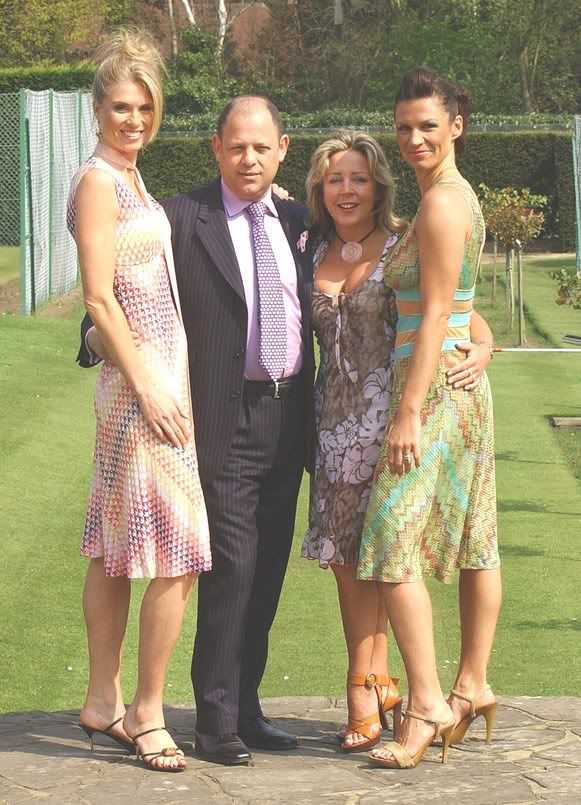
Last April, I had the privilege of speaking on behalf of Breast Cancer Campaign at a charity fashion show in Surrey. The event was organised by Julianne Finucane ( on my immediate left ) and Faith Brown was the main attraction. The event raised thousands for BCC and I'm delighted to have been asked to speak again at a similar event next month.

Ignorance is Bliss

At the local cafe in Euston last week, somebody asked me what Blogging was....." ain't that something you do on Hackney Marshes or somefin' " - in future, I must be careful who I engage with.......................

more on ignorance - the country this morning, is awaiting with bated breath, a financial report being given by Labour's Chief Treasurer, Jack Dromey ( Trade Union heavy, made good). He feels let down that he was made unaware of the "donations" given to New Labour before last years General Election. I guess the question on all our lips "is New Labour more sleazy than the last Conservative government"...........answers on a postcard to 3rd washroom along, Victoria Station...........................

Wednesday, March 15, 2006

Beware the Ides of March!!!


Well it's nearly 4pm on the afternoon of the 15th - and yes, I'm still here. I haven't been stricken by some awesome illness, or been hit by the "Number 11" bus. Or should that be Bendybus? Good ol' Ken.
In fact, today has been most uplifting. As ever, met some talented individuals at Steve Blacknell's amazing Network Experience. This group which meets in London's West End is full of media people looking for new opportunities. It's a a great forum for sharing ideas and telling a few dodgy jokes. You know, one never knows who one is going to meet - people seem to appear at the right time to solve a problem or to introduce you to a new idea. The power of networking. Never knock it!!

The photo is one of me outside Valencia railway station in the summer of 2003. The weather when I went back there a couple of weeks ago was somewhat different! ( Did you notice the Valencia orange? )

Tuesday, March 14, 2006

Thank God for Barry

Whilst trying to get to grips with my new Blogger account, my trusted "odd-job" man, Barry G. has successfully put up some new lighting and other items in my North London dwelling. I've known Barry for quite a few years now. Always reliable. How many of you out there have horror stories about builders?